
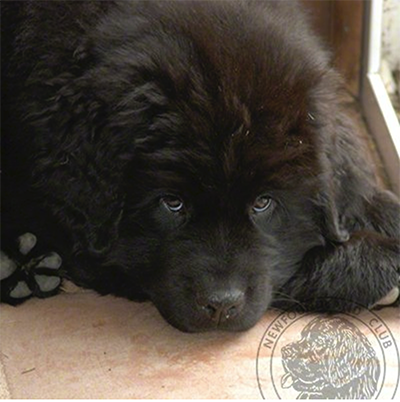
 Developing a good learning relationship with your Newf is built on a foundation of listening — on both sides. Learning is not a one-way street. As you spend time with your pup, you will begin to notice which types of reinforcement are effective and which fall flat. Being open to different training techniques and a variety of tools will give you greater success in the long run, and the result is a more well-rounded, emotionally stable adult dog who trusts you completely.
“Learning the value of silence is learning to listen to, instead of screaming at, reality: opening your mind enough to listen to your dog until you discover what is needed instead of imposing yourself in the name of training.”
— Brother Thomas, Monks of New Skete.
This is especially true with Newfoundlands, a breed renowned for their sensitivity and emotional intelligence. Newfs are not dogs who respond well to heavy-handed correction or relentless repetition. They respond to relationship. When training sessions feel collaborative rather than coercive, you will see a Newf come alive — engaged, willing, and eager to understand what you are asking.
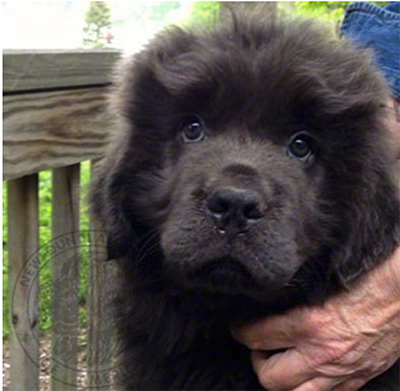 Understanding the general principles of behavior and training is an important cornerstone for all teaching, and these principles apply across many breeds and situations. Finding the specific techniques that work best with your pup, however, requires listening and learning from your own shared experience. Some of these foundational principles include:
• Timing is vital. Providing reinforcement at the instant a pup offers a requested behavior ensures the right action gets marked and repeated. Even a second's delay can muddy the message.
• Consistency is important. All teaching can be viewed as building blocks — adding more complex behaviors onto skills your pup has already mastered. Don't skip ahead and try to teach something your pup isn't ready to learn. Progress that feels slow is usually more durable.
• End every session on a high note. No matter how frustrated you feel over the course of teaching a new skill, step back and ask for an action your pup can do consistently and confidently. Finishing with success keeps your dog engaged and eager to train again tomorrow.
• Pay close attention to your pup. Learn what signs of stress and frustration look like in your dog. Pay close attention to their body language and what they are telling you about how the training is going. Yawning, lip licking, turning the head away, sniffing the ground — these are all signals worth reading. Just as important: pay close attention to your own body language. If you are distracted, frustrated, stressed, or in a rush before you even begin, your dog will pick up on all of that, and your sessions will suffer for it.
"The relationship between humans and dogs is a conversation, not a monologue. The most effective trainers I've ever seen are the ones who spend as much time watching their dogs as they do directing them."
— Patricia McConnell, Ph.D., The Other End of the Leash
McConnell's insight cuts to the heart of what makes training with a Newf so rewarding when it goes well — and so frustrating when it doesn't. These dogs are highly attuned to human emotion and social cues. They will tell you a great deal if you learn to pay attention to what they are saying.
"A dog that has learned to listen carefully will tend to pay more attention. A bit of meaningless chatter is fine every so often, but dogs don't speak our language and you don't want cues to become lost in the noise. When training, try not to talk too much. Effective communication comes through quality and clarity, not quantity."
— Karen Pryor
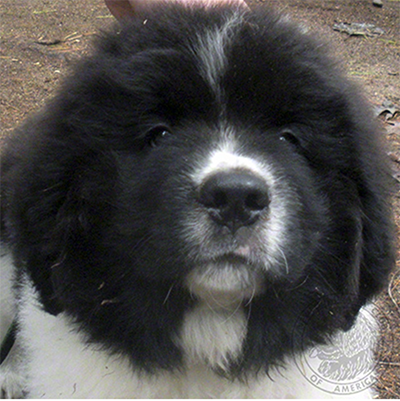 There's a well-known story about trainer and behaviorist Dr. Ian Dunbar challenging a roomful of professional trainers to prove their dogs could sit on cue. "Of course our dogs can sit!" said every trainer in the room. But then Dr. Dunbar asked them to give the sit cue while lying flat on the floor. Needless to say, most dogs did not sit. Why? The scenario was too unfamiliar. Even a well-practiced cue can become invisible when the context changes dramatically. This is a humbling reminder that dogs don't generalize the way humans do — they learn in context. A dog who sits perfectly in the kitchen may look at you blankly in a park or a pet store, not out of stubbornness, but because those environments feel like entirely different situations.
This is why developing a relationship with your dog means practicing in many different environments and scenarios. Take your training outdoors. Practice at varying distances. Ask for behaviors when you are sitting on the couch, walking away from your dog, or crouched at their level. The more varied your practice, the more reliable your dog's understanding becomes.
One great game to play with your pup is called "Hot and Cold", and it uses verbal communication and vocal tone to help your Newf find a hidden treat or toy. While your dog isn't watching, hide a treat somewhere in the room. Then use a calm, quiet tone — "colder" — when your pup moves away from the hidden item. As your dog moves closer, shift to a warmer, more excited tone — "hotter!" This game builds listening skills in a low-pressure, playful context. It also helps establish the unique shared "language" that develops between you and your Newf over time: the subtle shifts in your voice that tell them they're on the right track.
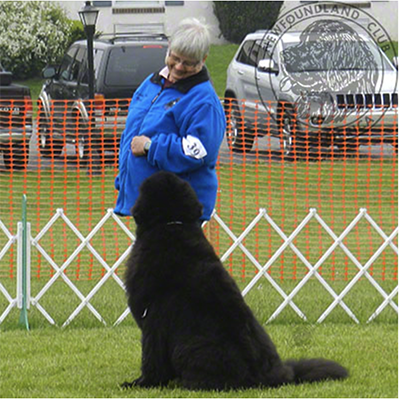 Patience, consistency, and timing are the keys throughout all of this. Don't let your attention lapse at the wrong moment. Reward the right behaviors promptly and generously. Remember that a randomly delivered reward — one that comes sometimes but not always — is one of the most powerful motivators in all of animal learning. That principle works both for you and against you: if your puppy figures out when your attention is elsewhere, they will take advantage of the opening. Use everything you learn about your individual pup to help them continue to grow. The reward for your efforts is something that can't be replicated: the companionship of a lifetime.